
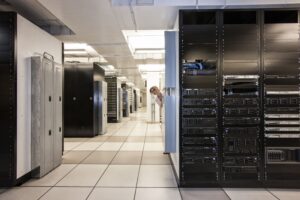
Computer room air handling unit by CITEC represents more than climate control technology—it embodies the forgotten foundation upon which Singapore’s entire digital economy precariously balances, a testament to how critical systems remain invisible until catastrophic failure exposes their importance. In this pursuit of technological supremacy, the city-state has constructed a digital empire generating over S$106 billion annually, yet this monument depends entirely upon moving air through rooms filled with humming servers.
The irony is stark: Singapore’s transformation into a global technology hub has created dependencies that mirror vulnerabilities the nation sought to escape through modernisation. Here, in climate-controlled fortresses across the island, the future of finance and governance depends upon precise temperature and humidity control—a balance that, when disrupted, triggers economic consequences far exceeding infrastructure costs.
The Brutal Mathematics of Thermal Failure
Singapore’s data centre industry consumes approximately 7% of the nation’s total electricity supply, translating to roughly 1,000 gigawatt-hours annually. Within these energy-intensive facilities, the relationship between cooling systems and operational continuity reveals itself through unforgiving statistics that expose the true cost of thermal mismanagement:
• Financial losses – data centre downtime costs an average of S$740,000 per hour across Singapore’s 70+ facilities
• Equipment destruction – server failures due to overheating can result in replacement costs exceeding S$2 million per incident
• Regulatory penalties – financial institutions face potential fines of S$10 million for service disruptions caused by infrastructure failures
• Productivity losses – businesses dependent on cloud services experience average losses of S$5,600 per minute during outages
• Reputation damage – service providers face customer churn rates exceeding 40% following major thermal-related failures
The Building and Construction Authority (BCA) estimates that 65% of data centre failures in Singapore stem from cooling system malfunctions, a statistic that underscores the critical importance of robust air handling systems in maintaining operational continuity.
The Science of Keeping Singapore’s Digital Heart Beating
CITEC air handling technology operates within narrow parameters that define the difference between digital prosperity and technological catastrophe. These systems function as the respiratory apparatus of modern computing infrastructure, continuously circulating precisely conditioned air through environments where minor temperature variations can trigger cascading failures.
The technology addresses Singapore’s unique climatic challenges with methodical precision. External temperatures averaging 30°C, combined with humidity exceeding 80%, create conditions that would destroy sensitive electronic equipment within hours without intervention. Air handling units for computer rooms must maintain internal temperatures within 2°C of optimal levels whilst controlling humidity to prevent condensation and static electricity.
The Infocomm Media Development Authority (IMDA) reports that facilities implementing advanced air handling systems achieve 92% uptime reliability, compared to 67% for those relying on conventional cooling approaches. This differential represents the margin between operational success and commercial failure in Singapore’s unforgiving digital marketplace.
The Colonial Legacy of Technological Dependence
Singapore’s relationship with cooling technology reveals deeper truths about technological dependence and national vulnerability. The island’s colonial past, marked by external control over essential infrastructure, finds modern expression in critical systems governing digital commerce. Computer room air handling units that sustain Singapore’s economic engine represent infrastructure colonialism, where technological sophistication masks fundamental dependencies.
The paradox becomes clear when examining Singapore’s energy consumption patterns. The nation imports nearly 100% of its energy requirements, yet dedicates massive resources to cooling systems that enable the digital economy. This creates a circular dependency where imported energy powers cooling systems that protect technology infrastructure, generating the wealth necessary to purchase more imported energy.
Environmental Contradictions and Cooling Realities
Singapore’s commitment to achieving carbon neutrality by 2050 collides directly with the energy-intensive requirements of data centre cooling systems. The National Environment Agency (NEA) estimates that cooling systems account for 40% of total data centre energy consumption, creating a sustainability challenge that exposes the environmental cost of digital progress.
Advanced air handling solutions address these contradictions through:
• Variable speed technology – reducing energy consumption by up to 30% during low-load periods
• Intelligent controls – optimising cooling delivery based on real-time thermal mapping
• Heat recovery systems – capturing waste heat for secondary applications
• Precision cooling – targeting specific thermal zones rather than blanket conditioning
• Predictive maintenance – preventing energy waste through early detection of efficiency degradation
The Green Building Council Singapore reports that facilities implementing comprehensive air handling optimisation achieve average energy savings of 25%, demonstrating that environmental responsibility and operational efficiency can coexist.
The Human Cost of Invisible Infrastructure
Behind Singapore’s gleaming technological façade lies a workforce of technicians, engineers, and maintenance personnel whose labour sustains the cooling systems that enable digital commerce. The Ministry of Manpower (MOM) estimates that over 3,000 skilled workers are employed directly in data centre cooling maintenance, representing specialised labour whose expertise becomes increasingly critical as systems grow more complex.
These workers operate in environments where a single mistake can trigger millions in losses, yet their contributions remain largely invisible to executives and policymakers who benefit from their expertise. The air handling systems they maintain represent the intersection of human skill and technological sophistication—a reminder that advanced automation requires human intervention to function reliably.
Future Trajectories and Technological Evolution
Singapore’s trajectory towards becoming a regional technology hub intensifies demands on cooling infrastructure. The government’s Smart Nation initiative, backed by S$2.4 billion in funding, will require data processing capabilities that far exceed current capacity. This expansion necessitates cooling solutions that can scale efficiently whilst maintaining the precision required for sensitive computing applications.
The emergence of edge computing and 5G networks creates new cooling challenges as processing power becomes distributed across numerous smaller facilities. Traditional centralised cooling approaches must evolve to address these decentralised requirements without compromising efficiency or reliability.
Singapore’s digital ambitions ultimately depend on mastering the fundamental physics of heat removal—a challenge that transforms the humble computer room air handling unit by CITEC into a cornerstone of national technological sovereignty and economic security.